Monday, May 2, 2016

Why I am voting for Grace Poe, and not for Binay, Miriam, Roxas or Digong (Part IV)

RODRIGO DUTERTE

Ohhhh, this would be fun.  Until it is no longer.

Let me start by saying that I like Digong as a person.  I don’t like spending an inordinate time around people I hardly know but I don’t mind spending time with him, talking about life, picking his mind, laughing unabashedly about jokes that we can share privately.  I don’t really drink but I will gladly be his bottle buddy.

I also admire his simplicity and lack of interest in material things.  All government officials should be like him in that respect.  Though I disagree with him opening his mouth without the benefit of prior brainwork, I don’t find any problem with his brash, tough and often kanto boy language.  I even find it a refreshing counterculture in a world that puts too much premium on polish and form.

I also admire what he has done in Davao, which many dream will be replicated in the entire Philippines. He walked the walk, and talked the talk. Feared, respected, revered – that’s who he is in Davao.  And Davao is relatively safer, more progressive and more conducive for living, than most Philippine cities. That, I give him.

Why I am not voting for Digoy?

I will not talk about his womanizing or his macho stance on anything that concerns gender and sexuality, or his beef against the church.  I will however talk briefly about two issues: federalism and his cozy stance towards China, before tackling the meat of my objection against him, which is his bloody roadmap to peace and order.

Federalism or feudalism?

Duterte is so sure that the only way for provinces, especially the most poor, to inch their way up the economic ladder is by switching to federalism where the local government has more control over its funds. There is even a slick animation about how federalism works doing the rounds of computers, drawing raves and "Oo ngas" from impressed viewers.

In theory, yes it is an alternative worth exploring.  But does it guarantee effective and good governance? Hell no!

Not when the same faces will occupy the federal state. In case it has escaped you, most of the poorest provinces are ruled over by the same faces, with the same surnames; who else but the same trapos, the political families, the people with guns and money to secure prime positions. Para lang ginawa mong official ang mga "kingdom" para sa mga sakim para lamang lalong payamanin ang mga ito dahil mas malaki na ang perang hahawakan nila.  At ang mga taong mahihirap na dapat maiangat ng pederalismo? Walang nagbago, mahirap pa rin.

It is not the form of government that ails the country.  It is the people tasked with running it ruining it.  Unless part of Duterte's pledge of switching to federalism comes with a vow to eradicate the cream of the crop of politicians skimming money from the people, particularly those on the provincial level, nothing is guaranteed. But last I heard, he is busy hobnobbing with them in his sorties, building ties and courting votes. So yes, change the form of government, retain the same bloodsucker, same old, same old results.

Made in China ties

This is going to be short.  There are issues that you can be practical about, and things that you fight for no matter what it takes.  The territorial dispute between China is non-negotiable.  The West Philippine Sea, and the islands and resources therein, is ours.  China is stealing it from us.  You don't reward a thief with the loot he stole from you.

Duterte is willing to do it. In fact, he sees it as the most sensible thing to do.  He treats our sovereignty like he treats lives, something that you can be practical with.


Lust for bad blood

The promise of absolute peace of mind resonates well with the Filipino forever looking behind his back for a real or imagined attacker.   Duterte has not made it a secret how he intends to make good on his promise – by pouring blood on the streets using overwhelming force of the police and military on anyone suspected of being a criminal.  I don’t think he is bluffing.  He did it in Davao, and he intends to do it all over the Philippines.

If police data can be trusted that over 90% of Philippine barangays are infected by illegal drugs, then there’s also that probability that you, yes you, will hear commotion, shouting and then gunshots one night, then wake up in the morning with a pool of blood being lapped up by your neighbor’s dog.  Or maybe by your own dog.

If you are lucky, you may even catch a glimpse of the “criminal” still lying where he fell, his eyes looking at an empty space as flies check out where the bullets entered and his brain matter exited.

If you are luckier, you may even have your young son or daughter with you; perfect occasion for you to teach a life lesson when your kid asks you why it had to happen, because then you will lovingly reply: “That what happens to the scum of society, baby.”  Not unlike perhaps to what Nazi sympathizers told their children when they were asked why their Jew friends and their family were being herded to trains at gunpoint, to be gassed and thrown to a heap of cadavers the way the dregs of society deserved to be disposed.

Chances are you might even personally know this dead scum.  And he was not that bad a person. In fact, he was nice to you and your kids.  He even had children of his own whom he also loved like you do yours.  And his children, now covered by his blood, are wailing because they lost the man they most loved.  Go ahead.  Tell them.  Their dad deserved to die.  Your vote was his execution order, remember?

Giving the police and military the power to extinguish lives is frighteningly dangerous.  We’re talking here of men in uniform not exactly known for their discipline, or their thoroughness in their investigative techniques. If today you ask an ordinary person what they think of the police, I’m sure he wouldn’t be faulted to say that he does not trust him, what with reports of men in uniform involved in all sorts of crime – drugs, robbery, kidnapping, and what have you. And now they are given the license to shoot -- suspects, personal enemies, business rivals or anyone who gets in the way will all be fair game. Dead men can’t talk. They will all be lumped together as bad people ordered by the president to be killed.

Guns for hire are making a killing now.  But wait till Duterte sits and the underground industry would have to hire additional hands to keep up with the demand.  What’s stopping people with deep personal grudges from hiring them to settle a score?

It would be a free kill season once Digong’s crime killing spree begins.  Now who is going to investigate hits not made by the official government death squad, the police?  So are they going to roll out and review their list and say that this and this are not in their target, so this must have been a crime?  Yup, that is going to happen.

And will the public cry foul when a dead body surfaces?  Or would they lump any dead person with a bullet in the head as a necessary sacrifice for the common good, never mind that this cadaver belonged to a husband whose wife simply wanted him out so she could run off with another man? Or vice versa?

It all boils down to this. Something must be terribly wrong when a candidate proposes to make state-sponsored killings of its own citizens an official government policy and many voters are actually gladly, frantically and desperately rooting for it.  I am no longer questioning its logic, but I am seriously wondering about its sanity.

All this, as they say, for the good of the country.  Really? Ask Duterte supporters why they are voting for him and most of them will acknowledge that it is for their and their family's peace of mind? Since when has a personal fear become the nation's?  And since when has murder multiplied by the thousands become a recipe for peace of mind?

Who ever said that the Philippines lack people who are willing to give up lives for the country does not know anything about how it now works.  There are millions of Duterte supporters willing and excited to do that, as long as somebody else does the dying.  And this includes plenty of Bible-quoting citizens who, before Duterte's presidential run, would profess in their social media accounts how God is mighty, powerful, loving and forgiving.  I am not too familiar with the Bible hence there must be some fine print hidden in the appendices about special cases when killing people en masse is justified.  Or perhaps, this is just a case of separation of the church and state. Tsaka na muna ang pangaral ng Panginoon, eleksiyon ito hindi review nang sampung utos.

I'm sorry.  Maybe I just don't love my country enough.  Or maybe I just don't care about peace of mind enough.  But I just can't entitle myself with the power to say that I have the right to live, while others are not just valuable enough to live another day.  That's what a vote for Duterte is. That's not what my vote is about.


Sunday, May 1, 2016

Why I am voting for Grace Poe, and not for Binay, Miriam, Mar or Digong (Part III)

MAR ROXAS

Poor Mar Roxas. He is reduced to an absurd caricature by memes created and shared by people whose anger for anything yellow surpasses their ability to think objectively.  

I believe that Mar is a decent guy, a stickler for structure (which can be good or bad), and someone who can be trusted to keep his hands off public money (And the collective eyebrows of the anti-Mar brigade shoots up).

He however has two weaknesses that are too humongous for him to overcome.  First, he belongs to a party. Second, he is Mar Roxas.

The Daang Matuwid catchphrase is weighed down by the many inconsistencies of its results over the past 5 years that repeatedly pushing for it renders it as an empty, or at best an unwieldy mantra.  I admit that the Aquino administration, despite the noise and scorch-earth conclusion of its detractors, has made significant headways in many areas of governance, including the promotion of tourism to local and foreign wanderlusts, filing of arbitration case in disputed territories and  – yes, the fight against graft and corruption particularly in DPWH where roads and bridges to nowhere and the 20% kickback were once standard and widespread practices.

But alas, good news is not news to the Filipino.  What’s news is DOTC mishandling MRT/LRT lines and miraculous bullets appearing inside passenger luggages at the airport, Deaprtment of Agriculture issuing import permits to smugglers and smugglers having their way at the Bureau of Customs, LTO collecting fees for non-existent stickers, plates and licenses, to name some of the spectacular blunders that make the prospect of continuing on the same road such a difficult sell.

So where is Mar in this mix? Unfortunately, right in the middle – the guy obligated to convince people that what is not working is actually working, or will eventually work given more time.  Tough pitch for any man to pull off; and I see only one way Mar doing it.  But he should have done it a looooonnngg time ago.

He should have risen above the muck and acknowledged the administration’s shortcomings, then swiftly moved to right the ship, starting with the obvious -- letting heads of people central to the Liberal Party, like Abaya and Alcala, roll. 

But no, Roxas is a team player, a loyal ally through and through that he would allow a workable ship to be needlessly weighed down by useless tonnage instead of throwing them overboard, saving the ship and making it perform better in the process.  He could have done it a long time ago and made a better impression of his leadership and decisiveness but, unfortunately, Mar would rather go down with the ship than cross personal ties.  And so now here he is, the pitiful receptacle for all the boos and brickbats of his friends’ misdeeds.

Another critical flaw that Mar cannot overcome is that he is Mar Roxas, part hacendero Roxas, part business mogul Araneta.  He studied in the best schools, worked for the best institutions, before finding his way to plum positions in the government.  Through it all, he has built a reputation as an effective suit with an array of X and O solutions he learned in the boardroom.  Nothing wrong with that except that Roxas has not learned the art of connecting with the masa who view suits as either their employer, their snooty neighbour or unreachable townmate, and sometimes their oppressor.

His handlers know this all too well hence the desperate moves to package him as an action star/fine gentleman character that won’t hesitate to do the dirty work – all these while a bloke with a camera happens to be conveniently by to preserve the selfless act for posterity (Insert your favourite meme here of Mar directing traffic, carrying a heavy sack of produce, almost killing himself riding a motorcycle on dirt, eating simple food with bare hands, and the list goes on).
 
Alas, connecting on a personal level is difficult to artificially manufacture. It’s like your stiff teacher cracking a joke and you forcing yourself to laugh at it just because it would be awkward for both of you if you did not. Pilit eh.   And this is no more evident in the viral video of Mar trying to spark a fist bump into an exploding firecracker with an obviously bewildered tyke. If Mar was wired with the masses, he would have realized that fist bumps, let alone an exploding one, are only familiar to those with regular access to the internet or cable TV where they can see hip shows featuring hip characters like Baymax, or ball games with players who show pleasure or approval with each other that way.

Oh, poor Mar. You’re a good man who became a joke because you are who you are.


Why am I not voting for Mar?

As far as qualifications go, I admit he paid his dues.  And his hands are clean. Pakibaba po ang kilay.  Kung lumalangoy man siya sa pera ay dahil pinanganak siya sa pera. Yung bahay ng pamilya niya ay nandun sa Araneta Center na nagkataon din namang kanila ding pag-aari.

He will make a “good time” president, like his predecessor and friend PNoy, which means he will also inherit his noisy detractors and adding some of his own.  But inevitably, there will be bad times -- another Yolanda, another earthquake, another Mamasapano, another catastrophe where people would look for strength in their leader.  And Mar the good time president will go back to his natural self, digging for Xs and Os and thinking that everything can be thought over using conventions and structures, instead of showing himself to be a leader that empathizes, assures and inspires.  

Sorry, Mar is not that president.

As exemplified by his handling of the Romualdez meeting at the most crucial time of the Yolanda tragedy in Leyte, the highly structured Mar will demand to be right more than he would want to be decisive.  It’s like someone telling him, “Sir, we need to go over the mountain ASAP so we can rescue survivors.”  And he would calmly reply, “Wait, did you say mountain? We need to confirm if it really is a mountain. Call Mr So and So and have it measured.  If it’s less than 2,000 feet then it is just a hill.  Until we have that straightened out, we will not scale the mountain, or the hill.”


But a Mar Roxas presidency is not fatal.  Filipinos have shown time and again, sympathetic president or not, that it will rise above the water, ruins or ashes and fight some more.  But it will be more divisive and hurtful than ever.  And that is not the way to build, unite a nation already in a terrible state of disunity.  

A Mar Roxas presidency will be Part II of Aquino’s.  Only, it would have more hecklers and detractors. God knows how much we need less of that and more of showing support and empathy for one another. Roxas is not cut out for that.


Why I am voting for Grace Poe, and not for Binay, Miriam, Mar or Digong (Part II)

MIRIAM DEFENSOR SANTIAGO

First of all, she is sick.  But even if she was in the pink of health, I would still not vote for her.

Miriam touts herself as a no-nonsense, incorruptible public servant, who is a master of the law and a diety of pickup lines.  The latter a talent which earned for her a slew of followers from the youth sector who lap up her jokes like she invented comedy.  She also thinks that everyone not agreeing with her position is stupid.

Miriam is a product of consistent self-promotion.  Be angry all the time, and she becomes no nonsense. Call everyone who does not agree with her stupid and she has an intelligence level all to herself.  Mingle with and entertain the young crowd and she becomes their darling, champion and savior rolled into one fuming beast.

Why am I not voting for Miriam?

For years I have taken note of the political scene and observed who is on whose side during times when true colors can be revealed.  And from what I have seen, Miriam has shown time and again that she is not incorruptible. Sorry guys, that’s true.  In fact, she is as trapo as they come; not hesitating to take advantage of situations that would benefit her or her family, at the detriment of the people who she claims to serve. 

Miriam has made a name for herself as a person with encyclopaedic knowledge of the law. However, if the doctrine “Those who have less in life must have more in law” is to be followed, then she has shown in critical moments that she would not hesitate to manipulate the law to benefit the high, the mighty, and the privileged.

Her young voters, enamored by her endearing combination of humor and feistiness, are too young to remember that not too long ago, Miriam was allied with corruption-personified Gloria Macapagal Arroyo -- practically lawyering for her and her ilk in the Senate as they got involved in one putrid controversy after another. Hello Garci and ZTE? Guess on whose side Miriam was?  Why? Because GMA enlisted her husband as a cabinet secretary, which goes to show that her and her family’s interests supersede any others’.

More recently, Miriam was former chief justice Renato Corona’s main defender in the impeachment court, interpreting the law to favor a man who betrayed his sacred duty as the foremost abider and defender of the law by having huge amounts of money (in peso and dollar denominations) that couldn’t be possibly supported,  let alone explained or justified by his declared sources of income. (His recent death does not change that narrative)

Oh. And she also uses her senatorial budget to rent an office in her very own building. Why? Because she can, and it is not illegal.  Delicadeza is not in the legal system but it is expected from someone who claims to be incorruptible.

But her most recent and perhaps most blatant betrayal of the Filipino people is her choice of Bongbong Marcos as his vice-presidential running mate.  Miriam is always claiming that she would bring change and yet she chooses to promote a candidate that represents a family that is very much responsible for the rotten system that we have now.

Miriam is not going to win, but her greatest contribution might be BBM's ascension to a heart beat away from the presidency.  One young facebook friend wondered aloud, if BBM was really corrupt, why would Miriam choose him as his VP?

I am just shaking my head when a vote for Miriam is now being touted as a vote for principles. She was given enough chances to show how her legal expertise can be of use to the many, instead she time and again chose to abuse it protect  the high and the mighty.


Yes, I find her jokes and even her funny at times. But no. She does not get my vote.  I hope she doesn't get yours too.


Why I am voting for Grace Poe, and not for Binay, Miriam, Mar or Digong (Part 1)

I know many of you would be asking Bakit Poe?, or think that, knowing how I  usually frame my thoughts, that I would negate the headline and debunk it in the end.  But no.  It is as clear as stated. I’m voting for Grace Poe and I’ll tell you why, and also why not for any of the other candidates.

I am not emotionally invested in Poe the way some supporters of other candidates are so I can firmly say that this is a product of thinking much more than feeling.  In fact, I want to get this vote done and over with the soonest, so that Filipinos can go back to what is more important, which is trying to be better for themselves and the people around them, including those whom they don’t know, instead of bickering about who among the candidates will wipe out all the problems of this benighted nation.  None of them has that omnipotence.

Every presidential candidate not named Binay brings a core of advantages to the position (Binay is simply rotten to the core), as well as baggages that will hamper his/her effectivity once in office.  My choice ultimately boils down to which weakness will not be fatal to the country in the short and long-term, and whose strong points will move us forward, closer I hope to a progressive and more humane tomorrow.

The mudslinging is so harsh in this campaign season that it is difficult to surface for air without getting hit.  I am not going to throw dirt here, but I will discuss the dirt that has already surfaced for each candidate, including Poe,beginning with the candidate with the most dirt attributed to him -- Jejomar Binay.

JOJO BINAY

Binay represents everything that is wrong in Philippine politics.  He lies, cheats and steals. And that’s just for breakfast.  It becomes an eat-all-you-can if you factor in the voracious appetite of his family members turned “public servants.”  Jojo has made working in government such a lucrative deal for his family that future generations of Binays will live princely lives if their loot is not recovered soon. And given the short term memory of pinoy voters, it is not unlikely that part of this ill wealth will be used to win back power someday, complete with the tall tale that the Binay years were the golden age of public service (shades of Marcos here).

I don’t blame Jojo for going all out for the presidency because he knows that, whoever wins,  it is almost certain that he and his family will spend daily prayer meetings in jail.  So he is pinning his liberty on the hope that enough poor people will believe his tale of a better life once he becomes president.  Unfortunately for him, it seems that he is now closer to Bilibid than he is to Malacanang.


So I don’t need to explain why I am not voting for him, as I would for other candidates.


Saturday, August 1, 2015

One falls move and an epic Malipunyo to Manabu attempt

My entire body hurts, even my normally quiet toenails are complaining.  A few days ago I, together with eight other people whom I have met for the first time, and Jun Dio, a former student for 2 or 3 meetings when I substituted for their ailing professor in Literature, and with whom I share a kindred affinity for curiosity and creativity, embarked on an ambitious trek that, at least on a best laid-out plan, would take us across the Malipunyo mountain range, more popularly known as Malarayat, in around 10 hours and a handful of bumps and grinds.

But like in any best laid-out plan, everything must work out as expected to get the desired result. Now here lies the problem. The level of difficulty for a hike on either Malipunyo or Manabu is rated easy to moderate, but an attempt on both, with three minor peaks in between in a single go by a group of reasonably fit but mostly newbie members, under wet conditions and minimal preparation (this was called by Jun on a 2 days notice), easily bumps this trek into the "Are you serious?" category.

Like children who didn't know any better -- apparently, we were.

Led by our local guide Rey Lobo, our team immediately setttled into a chatty line as we slowly snaked our way from the slightly inclined rocky road at the edge of the mountain where an early morning blue sky made the grass on our feet glisten with yesterday's rain, up to the slippery single mud tracks that signalled the end of the road for most motorized vehicles, and finally to a path that took us over wet boulders either enveloped with delicate moss or bordered by giant ferns. Irregularly lacing the ground were giant root stumps, indicating that the sky above was now replaced by an impressive canopy of towering trees, with branches adorned by curtains of vines and beautiful parasitic plants that are prized as decoratives in lowland gardens.

Because I'd like to ensure that no one is left behind and I have the tendency to stop and inspect anything that calls my attention, I designated myself as the team sweeper.


Always eager for moments of serendipity, my eyes were peeled like airport scanners for interesting details such as intricate cobwebs made by clever spiders, luminous butterflies that slice the air with playful rainbows, gaudy flowers that host nectar parties for insect pollinators, fruits that look edible and dangerous at the same time, wild orchids and bromeliads that wrap around trees like verdant, thorny snakes, and oddly shaped or colored rocks, wood and debris that, with some imagination, form anything from a musical instrument to a frozen animal, or any random object that the mind can conjure.

 My ears are also tuned in for the slightest rustle of small animals, the raucous cacophony of insects and frogs in wet bogs, and the melodious calls of birds searching for mates.  But what intrigued me the most was the flirtatious sound of gurgling water, gliding and colliding with rocks as it finds its way downstream.  I didn't see it just yet, but I knew that we were traversing parallel to a body of water.


I was the last to arrive at a rocky promontory where my hikemates have settled on top of boulders, resting and preparing for the obligatory selfie poses as white foamy river water eased its way through giant rocks, seemingly in a hurry to  get away, leaving sprays of mist in its wake.


There was the unmistakable drumming sound  of cascading water -- loud and nonstop. As I joined the group, there to the right was the most enthralling sight I have seen in a while: a beautiful waterfall with sparkling mountain liquid pouring down on a shallow wading pool -- perfect as a backdrop for a nice photograph.


But I had no time for pictures; that can wait;I had to do what I felt was necessary at the time. As soon as I parked my hiking bag on a boulder, I dipped one foot in the ice-cold water, placed the other forward, and then the other until my face felt the soft dribble of cool water instantly washing the exhaustion away, my arms spread wide, palms open in thanksgiving for the refreshing shower that literally came from heaven. It was bliss in wet perfection.


I heard squeals of envy, "Wooow, parang ang sarap!"  Apparently, it was only I who heard the call to immerse myself under the falls.

After a few minutes of having the wet pleasure all to myself, Sharmaine took off her baseball cap and waded in, screaming in delight in what I already knew was the feel of heaven.  Claudine followed, doing the same.

And then there were two


In a little while, half of the pack was under the water, with the boys still resisting, but not too long. Eventually, we were all -- except for Jun who took on the responsibility of preserving the moment in photos, and Rael (both  eventually joining) -- side by side, screaming and hollering in delight like young children who had experienced bathing under the rain for the first time.


And there were 9


The water came from all the way from the top of the mountain, travelling through cracks and crevices just to reach this point, the least we could do was to meet it halfway. It was 10 minutes of shared, unexpected magic.
.
Then it was time to continue our hike; we were just barely two hours into the 10-hour trek.


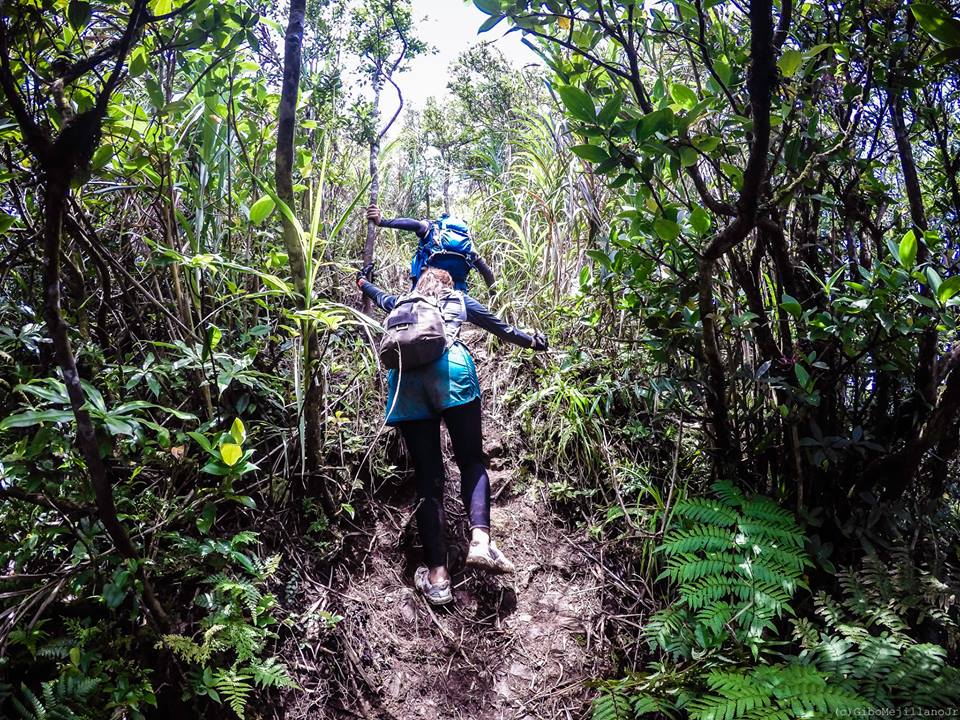
The path noticeably became steeper and the terrain more unpredictable, with only protruding roots and shrubs serving as handholds to protect the climber from a potential accident.  The slick trail created by intermittent rain, as well as our wet shoes' diminished traction all but ensured that slipping and butt smashes would happen with regularity. With me bringing up the rear, our contingent was transformed into a 30-meter long conga line of grunting, yelling and cursing wet climbers.

All around us was pristine forest, dark and imposing when seen from afar, humbling and breathtaking when experienced up close.  That a trail was carved at all in this dense jungle, including one that tunnels through a thick tangle of thorny bamboos, speaks so much about the creativity and determination of the trail maker to make something out of practically nothing at all; producing an adventure that is challenging as it is mesmerizing.


The problem with getting an extreme high at the waterfalls is that actually summiting Malipunyo comes more as a relief than a victory.  There were no high-fives and primal yells. The 360 degree view of surrounding areas, including Lipa where we came from, San Pablo, Cuenca, Tagaytay and just about every major  mountain in the Batangas-Laguna-Quezon corridor serving nothing more than an interesting conversation topic, rather than a must-selfie panorama, which it actually is.


Our conquest of the Malipunyo peak was so exciting that it lulled us to sleep after gobbling a quick lunch.


The hike to Manabu required us to retrace our steps until we reach a trail that connects us to it, which was easier said than done, especially that the trail was wet, muddy, slippery, and the shrubs and vegetation that one may use to arrest a fall or control a descent are treacherously laced with unassuming plants that have prickly thorns that can inflict anything from irritating itches to serious puncture wounds. Going down was slow and laborious, to say the least.  And if I may add, noisy.


Sweeping for a 10-man group that does not stay close together can be a bit stressful and tiring, especially when I hear sudden yells from blind spots.  I am relieved when it is followed by laughter or teasing, or both, which meant that it was nothing more serious than a quick roll on the mud, which happened to me twice, with one creating a particularly loud thud that Gibo, who was a few feet ahead of me, asked with an extended hand in case I needed help getting up, "Sir, okay ka lang?" I can only offer a rather embarrassed smile as my butt down to my legs were splayed helplessly on the ground, with only my backpack saving me from a total wipeout.

I like Gibo, he is a grounded kid, always mindful of his mother's reminders and his younger brother's safety as he negotiated the trail ahead of him.  He is also quick-witted. Margie -- anointed the group's Trail Queen because she has registered the most falls, often punctuated by sharp but short bursts of screams, yelps, squeals or crisp curses -- made another two-foot slider, which prompted her to pierce the silence with the unscientific term for the female genitalia.  She did this with such desperation and alarm in her voice that it was as if that this mysterious object was either missing or about to appear from thin air. Gibo seamlessly retorted: Saan? Margie kept the location secret though, so we continued moving down the trail, one sliding foot at a time, convinced that it was probably in a safe place.

After 6 hours of hiking, my body was already feeling the exertion, with aches and creaks appearing here and there, none of which was more bothersome than at the right side of my right knee, which stiffened and throbbed every time I stepped forward, and shot a jolting pain that travelled all over my right side when I had to bend it.  It was as if someone who had an ax to grind against me, perhaps someone I mercilessly bullied in highschool, suddenly decided to stop grinding the ax and smashed the wooden handle on my knee instead.

When we resumed the hike after a brief stopover at another trail guide's hut, I decided that it would be best to relinquish my sweeper duties to Jun and slotted myself right behind Mang Rey, our guide.  By this time, the sky had become ominously dark, crackling thunder rolling around the mountain range like a sadistic warden rattling his baton along the cells' steel bars. Rain was inevitable.

The tree in the middle are actually two trees that, for some reason or another, merged atop where they met.


Mang Rey was afflicted with polio when he was six years old, leaving him with a slight limp.  He also had involuntary movement in his left arm, which was constantly bent at the elbow, his wrist raised up to his shoulder. Because his head was slightly tilted to his left, Mang Rey appeared to be talking to someone on an imaginary phone, except that his hand kept swiveling at the wrist, his fingers almost balled to what resembled a half-hearted fist, with thumb and index fingers slightly pointed outward as if holding a precious stone, and the other three fingers delicately trapping a spider in a small gap between the hand.

With thunder booming and the sky turning even darker, it was a bit disconcerting to see Mang Rey's hand twirl counter-clockwise at the wrist, his two independent-minded fingers suggesting a retreat. After 7 hours of walking, we were closer to the end of the hike than its beginning so there was no way we were turning back.  I didn't want Mang Rey's hand to play mindgames on me so I decided to look down on his feet instead as they continuously moved one step ahead of the other. This, unfortunately, reminded me of my aching knee.

And the rain fell.  In light, intermittent trickle at first, then in vigorous regularity that lasted until we went down.

We exited the forest to a trail bordered by shoulder-high grass. Now there were no longer trees to shield us from the rain.  The only consolation was that had the sun been up, then we would be at its blistering mercy.  Instead, it was cool and pleasant.  We were hiking in a sea of clouds not unlike the famed airscape of Mt. Pulag.


Finally, after eight hours we reached Biak na Bundok, the penultimate peak before Manabu. The regular downpours from the previous weeks have turned the cogon grass verdant and lush, which appeared bathed in mist as clouds embraced our presence and clothed the entire surroundings, including the neighboring peaks and the air where the sky should be with a delicate silhouette of gray gossamer.  It could have been more mesmerizing and calming, except for the fact that we were drenched, tired, and desperately running out of daylight to accomplish our mission of scaling Manabu before heading back to civilization.

It was on this peak that it was decided that our next destination would be Barangay Talisay, where we kickstarted the day, instead of the final summit of Manabu.

We were on our way down when I began to hear voices from my toenails, particularly from the bunch from my left foot.  Because I had to alleviate the pressure from my right knee, I consciously shifted more weight to my left, especially when going down a trail, which my toes did not exactly appreciate as they had to carry most of the weight. Soon enough, I knew at least one toenail was broken as pain impulses echoed in my brain every time I had to put weight on my left foot.  Then it began to talk: Ick... Ick... Ick!  Not to be outdone, my left knee came out with its own distinct language: Aarrgg... Aarrgg... Aarrgg!

Soon, I was trodding under the rain with the chorus Ick-Aargg...Ick-Aargg... Ick-Aargg...Ick-Aargg playing in a crazy loop in my head.  It was not amusing.

But I was not the only one hurting.  All around me were undying declarations of pain: Ang sakit ng paa ko, Ang sakit ng hita ko, Ang sakit ng likod ko, Inaantok ako, Ang sakit na daliri ko, Ang sakit ng kamay ko, Ang sakit ng tinik ko...

Claudine though had a bigger problem.  She told her parents she would be out to shoot a school project. So aside from dealing with her collection of pain, she also had to device a fool-proof plan to convince her folks that she did what she said she would do.

But I had to give it to these kids.  While everyone was feeling some form of discomfort or another, none was complaining or swearing to give up mountaineering and all its self-inflicted torture altogether like many their age readily would.

Conversations turned to lighter things when the trail leveled to an unnoticeable descent, notably of the creature comfort variety: what to eat and where, what to do and how, who to be with and why. And yes, of course,because the next day was a Monday -- the constants of reality: school, work, daily grind.  We completed the 10-hour trek one peak short of our goal.  But no one seemed to mind.

My knee and toenails have stopped talking since.  We all are now back in our respective realities, each consumed with his/her own pursuits and missions in life.  But for ten hours on that particular Sunday, we shared this:

First row:  TJ Lamang, Gibo Mejillano, Rael Villavicencio Tan; Second row: Geraldo Mejillano, The Wet Biker, Sharmaine Castillo; Third row: Vanessa Carino, Claudine Catipan, Margie Maughan; Dulo: Jun Dio (Sorry sa mga taklob ang mukha, ito lang pic na ito ang kumpleto tayo:)


Photo credits to Sharmaine Castillo, Gibo Mejillano and Jun Dio


Friday, June 26, 2015

Idealism: The Mindset of People Who Think They Can Change The World


Idealism: The Mindset of People Who Think
They Can Change The World 


A Narrative Inquiry


By
Marcial I. Enginco
MA, Educational Psychology
UP Diliman, College of Education


For
Prof. Maribel R. Gaite
Methods in Educational Research


INTRODUCTION

Benigno “Ninoy” Aquino once famously declared, “The Filipino is worth dying for.” During that time, the Philippines was ruled by an iron-fist dictator – Ferdinand Marcos -- who used the might of the military and the police to intimidate the citizenry into turning a blind eye on the widespread abuse and corruption in the government, which was also undermining the moral foundations of a society still struggling to find its identity.  While Marcos and his cronies were wallowing in gold and ambition, the rest of the country was quickly spiraling into debt and despair.  Those who refused to be cowered chose to speak out; using the ember of truth to light fire in the hearts of people who have grown comfortable with their fear.   Scores among them were arrested, jailed and tortured; they were the lucky ones, they survived to tell their tale.  Many simply disappeared into the night, never to be seen or heard from again.   Others opted for armed struggle where a fate of either a violent end or a life of a breathing, crawling shadow awaited.
Ninoy Aquino became the face of the opposition.  He, too, has a story; told and retold by people eager to extol his greatness, hoping that those who will hear his tale will be inspired to do great things as he did.
Ninoy came from a powerful political clan in Tarlac.  And this influence and potential was further magnified when he married into the landed Cojuangcos, also of the same province. He was ambitious, intelligent, and eloquent; quickly capturing the imagination of the populace secretly pining for a force that will change the course of its miserable history, as well as the ire of Marcos who saw in Aquino the glib likeability that he once possessed but lost as he greedily sought permanency in power.
Like many of his peers who demanded change, Ninoy was also arrested, tortured and jailed.  But instead of serving to dampen the spirit of oppositionists, Aquino’s incarceration served as a glaring example of the regime’s lust for power and allegiance to brutality, which further, albeit slowly, shoveled fuel to the growing unrest.  Ever cunning, Marcos found a weakness in Aquino and a way to minimize the impact of the opposition leader’s growing defiance – his failing heart condition.  At the specter of dying uneventfully in his tiny jail cell, Ninoy accepted a heart bypass operation and eventual exile to the US.
At a time when the world wide web was not even a dream and long distance communication was limited to telephone calls and telex (which was a limited text messaging device also hooked to the telephone), and mass media was but a couple of censored networks and newspapers, Aquino’s health issues, distance and apparent settling into a more quiet, domesticated life in Boston, meant that Marcos was able to enjoy some breathing space from the person whom many considered as the one who can and would topple him from power.
The 70s to the 80s was a crucial juncture in modern Philippine history as exported Filipino labor, and essentially brain drain and migration, became practically a state-sponsored phenomenon.  And in the US Ninoy, his wife Cory and their children were enjoying their best times as a family; peace, togetherness and normalcy built around routine and predictability -- things that were cruelly denied them in the Philippines -- were theirs, permanently if they wished.  For many Filipinos, the privilege afforded the Aquinos meant not only a fresh start, but a way out of the political and economic quicksand of their nation. But to Ninoy, his time away from his homeland only strengthened his resolve that something must be done, and whatever that was, it had to be done going home.
Ninoy believed that he was meant for greater things, and this purpose went beyond what was good for himself and his family.  He was certain that it was his responsibility to the people to return. In his mind he alone, dead or alive, can lead the nation against Marcos, who was reportedly seriously ill that time, but who still had absolute control over the military and the nation’s coffers.
There was a sense of inevitability and acceptance in Ninoy’s demeanor when he, aboard that fateful China Airlines plane, intimated to reporters: My feeling is that we all have to die some time. Now, if it's my fate to die by an assassin's bullet, so be it. But I can't be petrified by inaction, or fear of assassination and therefore stay in one corner. I have to suffer with my people. I have to lead them because of the responsibility given to me by our people.
            The reporters’ television cameras followed Ninoy as he got up his seat and walked down the aisle towards the plane’s exit, a few seconds later, shots were heard and the nation’s history turned on its axis.

Difficult times and the rise of Idealists
Benigno  Aquino was an idealist, a visionary; in his mind, he saw the kind of life that Filipinos can have if they are free and able to pursue opportunities without fear or favor.  That Marcos loomed large to cloud that vision only made Aquino more passionate and determined about his self-imposed mission.
It would seem that difficult times give occasion for certain personalities to rise above the crowd, confidently and passionately showing them that things will be better.  Nelson Mandela emerged from 27 years in prison to end apartheid.  Bono of the Irish rock band U2 uses his clout and connections to raise hundreds of millions of dollars to stave off starvation in Africa.  Mother Teresa gave new meaning to compassion by taking care of the poorest and lowest classes of India.  Malala Yousafzai, then a Pakistani 15-year old student, survived the bullets of Taliban assassins who targeted her for her insistence to continue her schooling.  At 17, she became the youngest Nobel Peace Prize winner for her campaign on women’s rights, particularly to equal access to education.
The power of one person to change the lives of many and alter the world as we know it is rare but real and should never be underestimated nor ignored. What distinguishes the real game-changers from ordinary dreamers is their supreme confidence that, no matter the circumstance or seeming hopelessness of a situation, or how heavy the sacrifice may be, he can and will effect the change that he so desires.  This kind of mindset is what makes idealists such unique and potent individuals, worthy not only of appreciation but, more importantly, of emulation.

Understanding the Idealist’s Mindset
However, any attempt to use an idealist’s perspective as a template for molding one’s character, especially of students, begins with understanding how such a personality is formed and transformed, acquired and developed by looking into events, experiences and personalities that have contributed, in one way or another, to the development of such a transformative outlook in life.  Likewise, it is also important to examine significant junctions in the lives of the idealist to understand how such life decisions have led – serendipitously or by design into such a very ambitious role and/or purpose. 
This study will attempt to understand the mindset of idealists by closely examining the lives of two exemplars of idealism: Tony Meloto, of Gawad Kalinga, who dreams of a first-world Philippines where everyone has a roof over his head, abundant job and entrepreneurial opportunities to pursue, and genuine love for nation and compassion for others, and; Efren Penaflorida who believes that he can take away teenage gang members from a life of crime, violence and failed dreams into the realm of community, productivity and purpose through education.  Penaflorida was named CNN Hero for 2009 for his pioneering effort of bringing education to the slums through his roving library set on a kariton, a wooden pushcart.
The researcher will conduct a narrative inquiry into the personal and professional lives of the two subjects.

Idealism in schools
Different schools have different ideals.  Ateneo de Manila extols its students to be Man/Woman for Others, De La Salle molds its scholars in Religion, Morals and Culture, while University of Santo Tomas inculcates in theirs that there is Truth in Charity, UP simply instructs its men and women to go, Serve the People with honor and excellence.
None of these ideals, however, are individually taught in the respective schools as a specific subject or domain to master, but rather the sum total of values and teachings that may be learned, gleaned and experienced through various subjects, disciplines and activities.   While each university may have varying perspective to what is ideal, all share in the basic foundation that the internalized values are meant to be shown outwardly, with the larger public and community benefiting from such high moral grounding.  At least that’s how, on paper, it is designed to work.  You would think that with all the graduates of these universities proudly stepping into all kinds of fields and communities that social, economic and political ills will be extinguished, or at least diminished, and that the world will grow more humane and concerned for the whole, and not just for a part – sadly, that is not the case.  
In reality, many graduates of the top schools, UP included, leave their alma mater, ready to conquer the world, but not serve, change or better it.  Not a few of the best educated but with questionable motives end up in politics, business and industries; perpetuating inequalities that their alma maters instructed them to douse.
Ninoy Aquino must now be stirring in his grave.  His sacrifice has freed his countrymen from decades of silence.  But instead of rising up to empower themselves and their communities, many have grown dependent on what others can do for them.  And in the age of the internet and social media, many are making up for the years of being voiceless by making ranting and complaining a default mechanism to just about every problem that comes their way.  The Philippine society has grown noisy, not active.  That two of Ninoy’s immediate family members were catapulted to the highest position in the land, with varying degrees of success and missteps, did not succeed in bringing to total fruition Ninoy’s vision for his countrymen.
There are so many things that so many people can do to improve their or their community’s station.  But unfortunately, there are a lot more cynics than doers.  And those in the middle who are willing to help foster change are just waiting for leaders to show them what to do, and convince them with the sheer strength of their personality that it can be done.  We need heroes, idealists; those with the mindset that can tune out the noise and the apparent improbability of a cause to actually do something about what bothers them. 
I believe that a school’s ideals, as encapsulated in their mottos, should be revisited and examined if they are actually taking root in the way their students think and behave.  Failure of the students to imbibe such lofty principles is the failure of school to contribute better citizens and human beings.  By understanding why idealists think and behave the way they do, I believe that the information that will be gathered from this research will help educators – administrators, school psychologists, teachers -- to examine, recalibrate and direct their values formation to include such discovery.

Every person has the capacity and potential for greatness.  But how one accounts, interprets and integrates the lessons from his life’s challenges, decisions and circumstances often dictate which  finds, recognizes and uses this immense power and which one lets it slip away, often, not knowing that it was even there.  Essentially, idealism is a set of character traits – a mindset that allows and even compels one to take on challenges that many consider too big, too impractical, and too impossible for one person to think about, let alone accomplish.  
This research, Idealism: The Mindset of People Who Think They Can Change The World aims to identify and discuss this unique combination of traits by examining, observing and analyzing, through the lens of narrative inquiry, the lives of known idealists Tony Meloto and Efren Penaflorida.

Sunday, April 19, 2015

When spiders were more interesting than girls

I am flooded with memories every time I attend mass at the Fernando Air Base Chapel, where I was, a long time ago, an altar boy.  It must have been some kind a covenant made by our parents with God that everyone of us six Enginco boys would serve because I somehow found myself reluctantly following the footsteps of my Kuyas who have distinguished themselves as dutiful servants.  If I had my way, I’d be happier looking for spiders in far away fields and playing basketball at the plaza, instead.  I had the shortest tenure among all of us because I entered rather late and retired rather early. 

But I learned a lot of life lessons as an altar boy.

If you don’t know yet, the most important part of the mass is the ringing of the bell, which happens four times during the celebration; first, when the priest blesses the hosts by placing both his hands, palms down, over the chalice, second and third, when he offers the host by raising it so that the congregation will see, then the wine by doing the same, and lastly, when he drinks the wine which signals that everyone must now fall in line to partake of the feast.

For some reason, I found myself the only altar boy in the chapel one Saturday afternoon that a wedding was to be officiated.  It was not unusual for only one acolyte to serve in a mass, but it was for me because it was my first time.  The thing with being on a solo mission atop the altar is that you have no one to exchange furtive glances or elbows to the side with when you spot something, or someone interesting in the crowd.  So I did what I would normally do when left alone -- use my imagination to go some place.  That was when the revelation of the most important part of the mass dawned on me.

The wedding was going along fine, the bride and groom already delivered their respective agreement to hook up with one another for the rest of their lives with no one from the audience making a dramatic last minute plea, “Itigil ang kasal!”  As far as everyone was concerned, they were already married save for the honeymoon and the first official married kiss, which the priest will later on permit.

It was when I was kneeling on the merciless marble floor that the revelation happened.  At first, I thought it was God himself talking to me in my trance.  But when I came to, it was Father Oarga, his face so close to mine I could clearly make out the pockmarks on his cheeks.  I was tempted to name each one of them after the moon’s craters but he was saying something so urgent, his voice so deep and serious, like an extended sigh married to a grovel.  I was convinced a sacred secret was being passed on by a master to a disciple – Yuuuunnngggg belllllll….

Oh.  I missed it, didn’t I?  Twice, in fact. 

But not the third one, when I rang it so loud I must have made up for the lost two.  And certainly not the last, which signaled that my most favorite part of the mass would follow when I will have the chance to place a plate under a massgoer’s head, which would trigger the devout to stick out his/her tongue, which would then prompt the priest to place a host on it as a reward for falling in line.

Father Oarga rarely talked to me.  And his silence became complete after that incident.  I interpreted it as an unspoken command never to reveal the most important part of the mass to anyone.  But as great secrets go, I just had to let it out to free me from the burden of keeping it.

I didn’t know if I did not put out the proper solemn face when serving, or if I was not trusted enough to do the right thing at the right time because I have never been assigned to carry out the most regale and dramatic roles that an altar boy could ever play, such as carrying the burning incense which swung from a bronze chain, or lugging the large crosses, or ringing the wooden bell called matraca, which made a distinct takatakatakataka sound.  For a change, I would have loved to tak-tak-takatakatakatak-tak-tak it to provide some fresh rhythm to special ceremonies.   

But there was one role particularly reserved for  me though. And this came during Holy Week when Christ’s body, loaded on a carosa, would go around the military base in a long and winding procession.  This time I would be handed a very long pole and my duty was to go ahead of the caravan to look for low lying electric lines or protruding branches, which I would then raise with my instrument until the carosa passes by without a hitch.  It was not pretty, but I got the job done.

One of the reasons why many adolescent boys want to become a member of the Knights of the Altar is that it is one, if not the best way to meet girls.  And in summer, we had our counterparts – the catechists, whom we’d like to be around with most of the time.  With no sisters in the family, my only knowledge about interacting with the long-haired ones consisted mostly of my exposure to girl classmates in school.  But the only thing I knew about them is that they don’t like games for every time I tug on their hair or put thrash over it, they cry.  Same thing happens when I’d like to hear the sound that straps of trainer bras make on their back, or when I pull the chair under a girl who was about to take a seat.  Girls cry when you play games on them.  That much, I knew.

Now, there was one particular catechist who took interest in me: Charity.  I was in Grade Six, she was in first year.   She was pretty.  So pretty, that I didn't know what she saw in me, because at that time, I rarely looked at the mirror so that I could find out for myself.  But there she was, inside the church every time I was at the altar, whether it's on a Saturday, Sunday or Wednesday.  Apparently, she knew my schedule better than I did because she regularly checked on our assigned masses, which was posted on a bulletin board at the back of the church.

I would know where she was seated because just when everyone was quiet, Charity would make a sound with her throat – Eherm, eherm.  She would smile when my eyes located her presence.

During my favorite part of the mass, she would fall in line where ever I was assigned to handle the plate.  When it would be her turn to receive communion, I would jab the plate at her neck just hard and sharp enough to make her gag as she takes in the host.  That’s the best I could do.  I mean, as much as I’d like to pull her pretty bangs with my free hand, I just couldn't because the priest, or the lay minister, might slap my hand with his free hand.

Charity would wait for me at the end of the mass.  Sometimes she would hand me a letter.  I always responded with a smile for two reasons:  One, I didn't know what the hell to say to her; Two, because she was so darn pretty that grinning silly made perfect sense for clueless me.

Well, apparently, we were a couple in waiting.  My fellow knights thought so, and so did the other catechists, including Lea, who was also very pretty.  And as a pair, I guess it was mandated under the dating law that I should walk her home after the mass, which sounded strange to me because if she found her way to the church, then she could very well do the same going home.

Those were long, silent, awkward walks.  I didn't know what to talk to her about.  I don’t want to reveal to her that girls have the tendency to cry when they are exposed to me.  And I certainly did not want to boast about what I learned in school because even my teachers were not sure if I was getting anything.  And the more I couldn't tell her what was really on my mind every hour that I was awake – spiders, the ones with long reddish legs and hairy torsos.

I loved fighting spiders.  And I spent a great deal of my free time making long hikes under the scorching sun, alone or with my cousin Adrian, to far away fields where somewhere underneath the leaves and twigs of dried brushes and shrubs hid these fiercely majestic creatures.

I did not have the courage to ask Charity if she liked spiders.  But I was always optimistic that she would pop the question herself.  That never came though.

Charity liked to see me much more often than our once a week date at the church.  One afternoon, as I was inspecting my haul of spiders from a long, hot hunt, I spotted from a distance Charity with Gay, her cousin and best friend, and another cousin who was the prettiest of the three but who was already in fourth year high school, walking towards our home.  I didn’t know what to do then.  So I did what any self-respecting spider-loving-adolescent would do – run as fast as I could, so fast that I would be a blur and they wouldn’t notice me escaping, and so light on my feet that I wouldn’t stir even a speckle of dust that will give them a hint that I was even there.

That incident convinced me one thing: If a girl wanted to see you, she will.  And I think that it was mighty selfish of her to show up unannounced because I could have just as easily hurt myself running away from her.

I was already 5’7” when I was in first year high school.  And I began noticing that I was fast outgrowing the Sotana which garbed my altar service.  While I have grown adept at ringing the bell at the right time, I was also growing conscious of how I stuck out like a sore thumb when I was at the altar.  By then, my passion for spiders had waned, which was replaced with my love for playing basketball where I was in my place, considered a budding superstar.  Though Charity still attended the masses I served, her letters and my budding romance with her were put on hold.

The highlight of my summers became organized basketball where, with my quickness and jumping ability, I was fast gaining the reputation as a must-see player.  During one intense game, I heard a familiar voice sweetly call out my name; it was Gay, smiling.  She was with Charity, and she was very pretty, especially when she was giving me that look.  I did not say hi, I was playing a game.

I still hang around with my sacristant friends when I was in second year high school, but my service at the altar became less frequent.  By then, the sotana which once reached up to my heels was now hanging at my knees.  Donald, a friend who was a head shorter than me, took interest in Charity.  He had sisters and he looked at the mirror more often.  He would walk Charity home, and they had things to talk about.  He eventually became Charity’s first boyfriend.

I still did not understand girls then.  They were just not interested in games.